
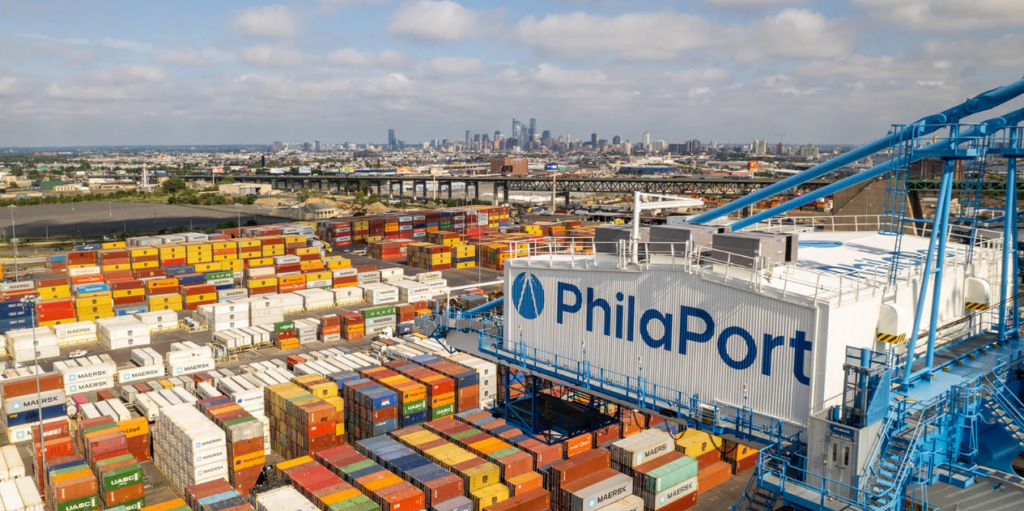
PHILADELPHIA’s port has become a vital gateway for Asia-Pacific trade, handling nearly 900,000 TEUs (twenty-foot equivalent units) in 2025, a record high and a 6% increase year-on-year. For Philippine producers, Philadelphia is not just a port of entry, but a distribution hub into the U.S. market.
The port’s specialization in temperature‑controlled cargo makes it a natural entry point for Philippine exports, while ASEAN’s broader trade profile of — manufactured and consumer goods — increasingly flows through East Coast ports.
Philadelphia’s Strategic Role
The Port of Philadelphia (PhilaPort) has emerged as one of the fastest-growing hubs on the East Coast, with container volumes up 39% since 2020. It is recognized as a leading U.S. port for chilled and frozen goods, with almost two‑thirds of its imports in 2025 classified as temperature‑controlled cargo.
With strong rail and trucking connections, goods arriving at Philadelphia’s docks move efficiently into supermarket supply chains across the East Coast and Midwest. This infrastructure supports exporters seeking faster access to major U.S. consumption centers.
ASEAN and Philippine Opportunities
ASEAN exports surpassed US $2 trillion in 2024, with the United States accounting for US $339 billion of that total. Electronics, apparel, and food products dominate the flow, and East Coast ports like Philadelphia are increasingly positioned to capture a share of this traffic.
In 2025, Manila and Washington, D.C. reached a preliminary trade agreement adjusting tariffs on key goods, opening opportunities for Philippine companies to expand exports.
Philippine products – including bananas, pineapples, and coconut oil – are well suited to Philadelphia’s cargo capabilities. The city’s logistics network enables firms to move beyond traditional West Coast entry points and reach East Coast and Midwest consumers more directly.
“The World Bank and S&P have ranked Philadelphia as the #1 most productive port in North America for the second year in a row,” said PhilaPort’s Senior Director of Marketing, Sean Mahoney. “We are excited to use that productivity to serve U.S. exporters to the growing ASEAN economies, and to be a gateway for ASEAN exporters to the U.S. East Coast and Canada. Although we do not currently have a direct service with ASEAN nations, we are working hard to get that connection.”
56th WTCA Global Business Forum
Philadelphia will host the 56th annual WTCA Global Business Forum (GBF) from April 19 to 22, 2026, organized by World Trade Center Greater (WTC) Philadelphia. The event is expected to bring together business leaders, investors, and policymakers from around the world.
“Philadelphia is proud to host and invite our global partners to join us as we highlight the leadership, ideas, and connections shaping the future of international business,” said Thomas Young, President and CEO of WTC Greater Philadelphia. “For participants, that translates into practical outcomes – meeting potential partners, exploring U.S. market entry strategies, and identifying investment opportunities in one of the country’s most dynamic regions.
Several Philippine companies spanning food products, logistics, advertising, and sustainable materials have already expressed interest, signaling growing engagement with U.S. trade corridors.
“Logistically, we sit in one of the most connected corridors in North America. The Port of Philadelphia continues to expand its global shipping connections, and our proximity to New York; Washington, D.C.; and major gateways around the world makes it easier for companies to build transatlantic relationships,” Young added.
The Forum provides a setting for exporters, freight forwarders, distributors, and logistics providers to assess commercial opportunities and distribution strategies. Discussions will cover market access, tariff developments, and supply chain resilience — issues directly relevant to firms moving goods into East Coast and Midwest markets.
Looking Ahead
ASEAN–U.S. trade continues to expand, with routing decisions shaped by proximity to markets, cargo specialization, and supply chain resilience. Philadelphia’s infrastructure — particularly temperature-controlled cargo handling and multimodal logistics — positions it as a practical East Coast option for regional exporters. Leveraging East Coast entry points alongside established West Coast routes can enhance both market reach and operational flexibility as U.S.-bound trade volumes grow.


